



Women and Alcohol

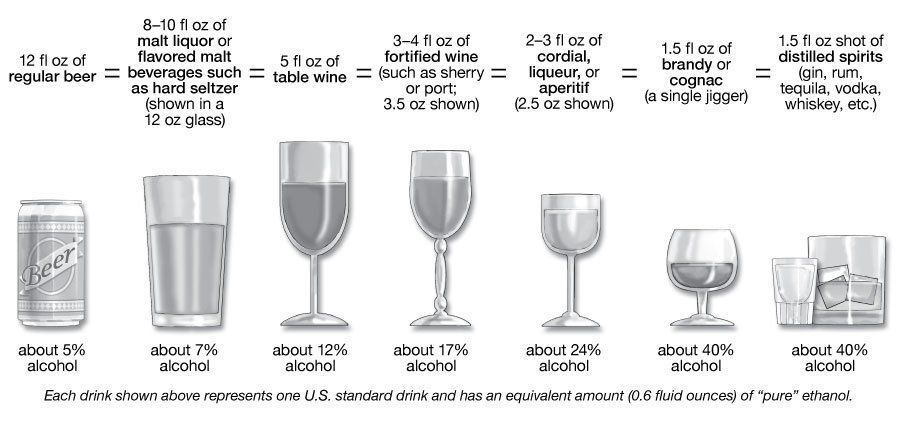
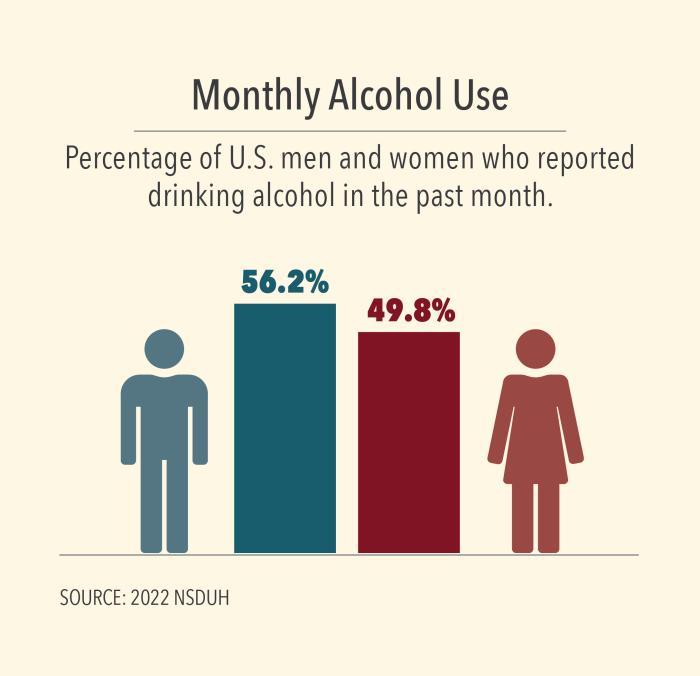
Research shows that alcohol use and misuse among women are increasing.1,2 While alcohol misuse by anyone presents serious public health concerns, women who drink have a higher risk of certain alcohol-related problems compared to men.3 It is important for women to be aware of these health risks and of the 2020–2025 Dietary Guidelines for Americans so that they can make informed decisions about alcohol use. Adult women of legal drinking age can choose to not drink or to limit their intake to one drink or less in a day, when alcohol is consumed.4 This amount is not intended as an average but rather as a daily limit. Alcohol-related risks may be minimized, though not eliminated, by limiting intake. Some individuals should avoid alcohol completely, such as those who are pregnant or might be pregnant.4
Why Do Women Face Higher Risks?
Studies show that women start to have alcohol-related problems sooner and at lower drinking amounts than men and for multiple reasons.3 On average, women weigh less than men. Also, alcohol resides predominantly in body water, and pound for pound, women have less water in their bodies than men. This means that after a woman and a man of the same weight drink the same amount of alcohol, the woman’s blood alcohol concentration (the amount of alcohol in the blood) will tend to be higher, putting her at greater risk for harm. For example, research suggests that women are more likely than men to experience hangovers and alcohol-induced blackouts at comparable doses of alcohol.5,6 Other biological differences may contribute as well.
What Are the Health Risks?
Medical Emergencies and Deaths
Women, compared to men, have had larger increases in alcohol-related emergency department visits, hospitalizations, and deaths in the past 20 years.7
Alcohol Use Disorder
Alcohol use disorder (AUD) is characterized by an impaired ability to stop or control alcohol use despite adverse social, occupational, or health consequences. It is a spectrum disorder and can be mild, moderate, or severe, and it encompasses the conditions that some people refer to as alcohol abuse, alcohol dependence, or the colloquial term alcoholism. (To be diagnosed with AUD, a person must meet certain diagnostic criteria outlined in the Diagnostic and Statistical Manual of Mental Disorders, 5th edition [see www.niaaa.nih.gov/sites/default/files/DSMfact.pdf]). AUD can cause lasting changes in the brain that make people vulnerable to relapse. Women are less likely than men to receive treatment for AUD.8
Liver Damage
Women who regularly misuse alcohol are more likely to develop alcohol-associated hepatitis, a potentially fatal alcohol-related liver condition, than men who drink the same amount.9 This pattern of drinking can also lead to cirrhosis (permanent liver scarring).
Heart Disease
Long-term alcohol misuse is a leading cause of heart disease. Women are more susceptible to alcohol-related heart disease than men, even though they may consume less alcohol over their lifetime than men.3
Brain Damage
Research suggests that alcohol misuse produces brain damage more quickly in women than in men.10 In addition, a growing body of evidence shows that alcohol can disrupt normal brain development during the adolescent years, and there may be differences in the impact of alcohol on the brains of teenagers who drink.11 For example, in one study, teen girls who reported binge drinking, but not teen boys who reported binge drinking, showed less brain activity and worse performance on a memory test than peers who drank lightly or abstained.12 Similarly, teen girls who drank heavily showed a greater reduction in the size of important brain areas involved in memory and decision-making than teen boys who engaged in heavy drinking.13 Women also may be more susceptible than men to alcohol-related blackouts, which are gaps in a person’s memory for events that occurred while they were intoxicated. These gaps happen when a person drinks enough alcohol to temporarily block the transfer of memories from short-term to long-term storage—known as memory consolidation—in a brain area called the hippocampus.6
Breast Cancer
There is an association between drinking alcohol and developing breast cancer. Studies demonstrate that women who consume about 1 drink per day have a 5% to 9% higher chance of developing breast cancer than women who do not drink at all.14–16 That risk increases for every additional drink they have per day.16
Alcohol and Pregnancy
There is no known safe amount of alcohol consumption for women who are pregnant or might become pregnant. Prenatal alcohol exposure can cause children to experience physical, cognitive, and behavioral problems, any of which can be components of fetal alcohol spectrum disorders. Drinking during pregnancy can also increase the risk for preterm labor.
Some Women Should Avoid Alcohol Entirely
According to the 2020–2025 Dietary Guidelines for Americans, it is safest to avoid alcohol altogether if you:
- Are taking medications that interact with alcohol
- Are managing a medical condition that can be made worse by drinking
- Are under the age of 21, the minimum legal drinking age in the United States
- Are recovering from AUD or unable to control the amount you drink
- Are pregnant or might be pregnant
In addition, certain individuals should avoid alcohol completely, particularly those who experience facial flushing and dizziness when drinking alcohol. Also in this category are older adults, anyone planning to drive a vehicle or operate machinery, and individuals who participate in activities that require skill, coordination, and alertness.
To see whether your pattern of alcohol use puts you at risk for AUD, please visit Rethinking Drinking at: www.rethinkingdrinking.niaaa.nih.gov
1. White A, Castle IJP, Chen CM, Shirley M, Roach D, Hingson R. Converging patterns of alcohol use and related outcomes among females and males in the United States, 2002 to 2012. Alcohol Clin Exp Res. 2015;39:1712–26. PMID: 26331879
2. Slade T, Chapman C, Swift W, Keyes K, Tonks Z, Teesson M. Birth cohort trends in the global epidemiology of alcohol use and alcohol-related harms in men and women: systematic review and metaregression. BMJ Open. 2016;6(10):e011827. PMID: 27797998
3. Erol A, Karpyak V. Sex and gender-related differences in alcohol use and its consequences: contemporary knowledge and future research considerations. Drug and Alcohol Dependence. 2015;156:1–13. PMID: 26371405
4. U.S. Department of Health and Human Services (HHS), U.S. Department of Agriculture (USDA). Dietary guidelines for Americans, 2020–2025. 9th ed. Washington: HHS and USDA; 2020 [cited 2022 Jul 13]. Alcoholic beverages; p. 49. Available from: https://www.dietaryguidelines.gov/sites/default/files/2020-12/Dietary_Guidelines_for_Americans_2020-2025.pdf.
5. Vatsalya V, Stangl BL, Schmidt VY, Ramchandani, VA. Characterization of hangover following intravenous alcohol exposure in social drinkers: methodological and clinical implications. Addict Biol. 2018;23(1):493–502. PMID: 27860050
6. Hingson R, Zha W, Simons-Morton B, and White A. Alcohol-induced blackouts as predictors of other drinking related harms among emerging young adults. Alcohol Clin Exp Res. 2016;40(4):776–84. PMID: 27012148
7. White AM. Gender differences in the epidemiology of alcohol use and related harms in the United States. Alcohol Res. 2020;40(2):01. PMID: 33133878
8. Gilbert PA, Pro G, Zemore SE, Mulia N, Brown G. Gender differences in use of alcohol treatment services and reasons for nonuse in a national sample. Alcohol Clin Exp Res 2019;43(4)722–31. PMID: 30807660
9. Guy J, Peters MG. Liver disease in women: the influence of gender on epidemiology, natural history, and patient outcomes. Gastroenterol Hepatol. 2013;9(10):633–639. PMID: 24764777
10. Hommer DW. Male and female sensitivity to alcohol-induced brain damage. Alcohol Res Health. 2003;27(2):181–5. PMID: 15303629
11. Jones SA, Lueras JM, Nagel BJ. Effects of binge drinking on the developing brain. Alcohol Res. 2018;39(1): 87–96. PMID: 30557151
12. Squeglia LM, Schweinsburg AD.,Pulido C, Tapert SF. Adolescent binge drinking linked to abnormal spatial working memory brain activation: differential gender effects. Alcohol Clin Exp Res 2011;35(10):1831–41. PMID: 21762178
13. Seo S, Beck A, Matthis C, Genauck A, Banaschewski T, Bokde ALW, Bromberg U, Büchel C, Quinlan EB, Flor H, Frouin V, Garavan H, Gowland P, Ittermann B, Martinot JL, Paillère Martinot ML, Nees F, Papadopoulos Orfanos D, Poustka L, Hohmann S, Fröhner JH, Smolka MN, Walter H, Whelan R, Des rivières S, Heinz A, Schumann G, Obermayer K. Risk profiles for heavy drinking in adolescence: differential effects of gender. Addict Biol. 2019;24(4):787–801. PMID: 29847018
14. Shield KD, Soerjomataram I, Rehm J. Alcohol use and breast cancer: A critical review. Alcohol Clin Exp Res. 2016;40(6):1166–81. PMID: 27130687
15. Li CI, Chlebowski RT, Freiberg M, Johnson KC, Kuller L, Lane D, Lessin L, O’Sullivan MJ, Wactawski-Wende J, Yasmeen S,
Prentice R. Alcohol consumption and risk of postmenopausal breast cancer by subtype: the Women’s Health Initiative observational study. J Natl Cancer Inst 2010;102(18):1422–31. PMID: 20733117
16. Allen N.E.; Beral V.; Casabonne D.; Kan S.W.; Reeves G.K.; Brown A; Green J.; Million Woman Study Collaborators. Moderate alcohol intake and cancer incidence in women. J Natl Cancer Inst. 2009;101(5):296–305. PMID: 19244173